Lawn and grass diseases
Various forms of lawn disease can ruin grass and infect newly-laid turf, if left untreated. To help avoid this, Perfect Ground Solutions provide lawn disease treatment and prevention services to customers throughout Hertfordshire.
Similar to how we treat and prevent plant diseases, we apply various chemicals and offer the following advice as part of our lawn care services:
We also provide grass disease treatment and prevention for sports surface services such as football, cricket and golf courses. Our pitch services also include renovation and nutritional feed.

Descriptions, causes and prevention tips for grass and turf diseases
Fusarium Patch Monographellanivalis
This disease is caused by the fungus Monographellanivalis and is commonly found in the spring or autumn when damp warm conditions persist.
The spores germinate on the grass if the leaves remain wet for 48 hours. It can be a significant problem especially in newer lawns or those that have had significant nitrogen applications causing fresh or soft growth at the wrong time.
Good lawn feed, nutritional advice and correct lawn care will reduce the risk of infection. Where there is a significant risk, such as irrigated and enclosed lawns, new turf or freshly grass seeded areas, fungicides may be required to maintain control.

Red Thread Laetisariafuciformis
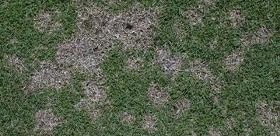
Red Thread is a common problem on many lawns, with patches of dead-looking grass appearing up to 20cm in diameter. These are best viewed in damp conditions or on dewy mornings when they will clearly have a pinkish tinge.
Pinkish-red, gelatinous, thread-like structures (stomata), 1-2mm (less than ¼in) in length, are produced on the leaves. Grass is more susceptible to problems such as this if it is under stress. This may be a several reasons, lack of nutrition is a major reason but this may be because the soil is in poor condition rather than the fact that no nutrition has been applied. Often fertiliser is thrown at a problem without the problem being interrogated first.
Good soil management (drainage, aeration and thatch removal) are key to preventing Red Thread appearing but if it does appear, nitrogen applications are usually able to remove the problem but do not apply straight nitrogen towards the autumn as this will produce lush growth which in itself will be more susceptible.
Fungicides can easily be applied to provide a quick fix to formal or show lawns. If you need any specific advice, please feel free to get in touch so that we can provide advice.


Dry patch
This can be a very annoying problem which shows up after dry periods when lawns can’t recover, leaving ugly dry patches throughout. Dry patches are caused by the production of waxy resins by naturally occurring soil fungus.
These resins bind the soil particles together causing the soil to repel water and become hydrophobic.
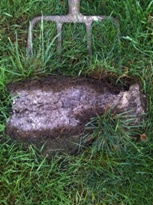
Normally, these resins are washed away and are simply part of day to day ‘living soil’ activities. However, when the soil becomes ultra-dry, as often happened in the spring, they remain and cause dry patch problems. The soil in these patches will be denser than the surrounding green patches, which can be tested if you try to push a garden fork into the areas. In some cases, fungal mycelium can also be seen in the soil.
With the soil particles bound up, the whole system grinds to a halt, making it difficult to cure as rain water is repelled. Forking the area (push in a fork and “wiggle”) will help, as will the addition of wetting agents.

Fairy Rings
Fairy rings are caused by soil borne basidiomytes and are natural soil fungi that live in the soil, breaking down organic matter.
There are different types of fairy ring, ranging from a full circle of mushrooms, often accompanied by a ring of dead grass, to simple shapes of darker coloured grass.
The mushrooms that occur, mainly in spring and autumn are simply the fungi flowering and trying to spread their spores. Often, if you dig up a little of the soil, you can see the mycelium of the fungus in the soil.
Treatment and control of this disease can be achieved, but each case varies, so once we’ve visited and had a look, we can advise properly.
Lawn Rusts
There are a range of fungi that cause lawn rusts, the most common being Puccinia spp.
Although not a major problem, this lawn disease does occur from time to time, mainly on unhealthy grass and is easily identified by many small yellow of brown pustules on the leaf of the grass, giving it a generally yellow appearance.
Instant treatment is simple, using professional fungicides, although it is better to understand the over-riding cause in the longer term, to stop this grass disease from returning.
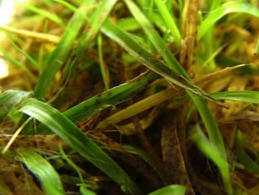
Dollar Spot Sclerotiniahomoeocarpa
This disease can be mistaken for Red Thread in its early stages, but can be identified by inspecting the individual grass leaves which show lesions, often around the whole girth of the leaf.
It does not affect the crowns or roots but can be unsightly when present. Dollar Spot is mainly a hot weather disease, found in closely mown irrigated turf.